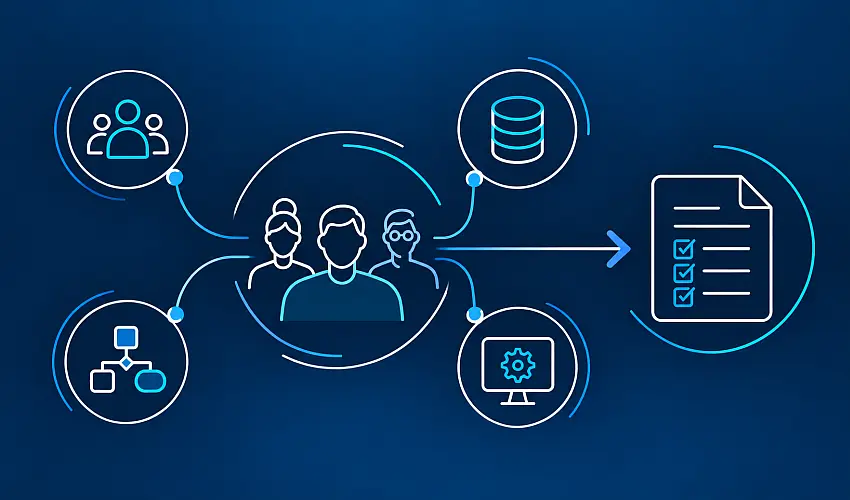
Understand before we recommend.
Technology projects rarely fail because teams cannot build software. They fail when the
problem, the requirements, or the environment in which the solution
must work are not sufficiently understood.
We begin by understanding the business need, the people involved, how work is actually
performed, the available data, existing systems, constraints, and the
outcome the organization is trying to achieve.
Do not assume. Do not judge. Understand.
A requirement can be perfectly documented and still be the
wrong requirement.
Stakeholders see the problem from different perspectives. Existing processes often
contain exceptions that are not immediately visible. Data may tell a
different story from established assumptions. Legacy systems impose constraints, while
users develop ways of working that formal process documentation
does not capture.
If these realities are discovered after development begins, the cost appears as rework,
delay, complexity, and ultimately solutions that do not fully address the
need.
Understanding early is less expensive than correcting assumptions
later.
We bring business and technology perspectives together from
the beginning.
We listen to stakeholders, examine processes and data, understand the existing
technology environment, identify dependencies and constraints, and
distinguish stated requirements from the underlying business need.
We use AI to accelerate the analysis of documents, conversations, data, requirements,
and patterns across large amounts of information. This allows us to
examine more evidence and identify inconsistencies and relationships faster.
But AI does not decide what matters.
Technology accelerates the analysis. Experience and judgment create
understanding.
That understanding becomes the foundation for requirements, priorities, solution design,
and delivery.
Stakeholder Discovery
Understand objectives, perspectives, needs, constraints, and priorities.
Business & Process Analysis
Examine how work happens today and identify dependencies, gaps, and opportunities.
Data & Systems Discovery
Understand available data, applications, integrations, infrastructure, and technical
constraints.
Requirements Definition
Translate business needs into clear functional, non-functional, data, integration,
security, and user requirements.
Requirements Validation & Prioritization
Challenge assumptions, resolve inconsistencies, establish priorities, and define
acceptance criteria.
Delivery Readiness
Create a sufficiently clear and shared understanding for architecture, design,
estimation, planning, and execution to begin.
Shared Understanding
Business and technology teams understand the problem and intended outcome.
Clear Requirements
Needs are translated into actionable and testable requirements.
Better Decisions
Priorities and recommendations are grounded in evidence rather than assumptions.
Less Rework
Ambiguities and conflicts are addressed before they become expensive development
problems.
Discovery is complete when there is enough shared understanding to make informed decisions and move confidently into design and delivery.


© Copyright 2024 By Ansigo
 Discovery &
Requirements
Discovery &
Requirements